Industry report · Version 1.0 · Global scope · Research cutoff: 21 October 2026.
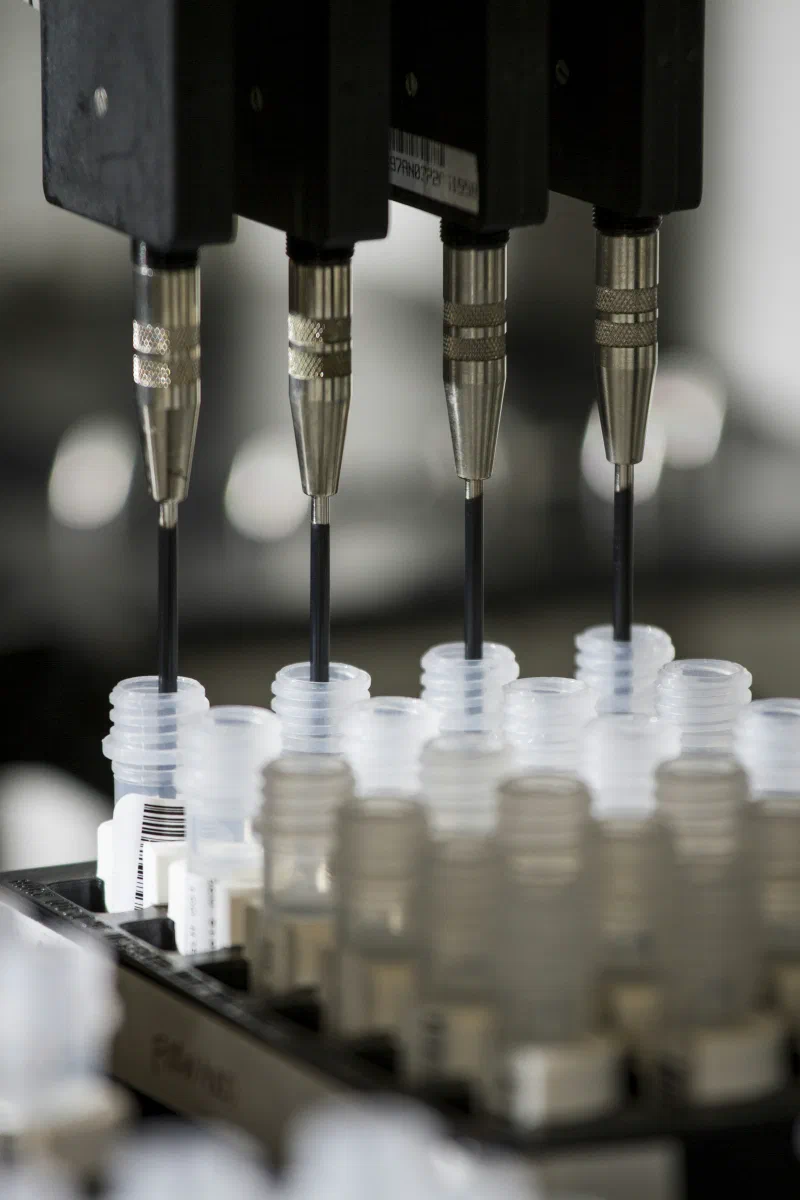
Automated sample handling in a research laboratory. Illustrative image; not a GLP-1 manufacturing site. Photo: National Cancer Institute / Unsplash, used under the Unsplash License. View uncropped original.
Bilingual review report (Word) · Bilingual review report (PDF) · English manuscript · Evidence records
The downloadable bilingual review files retain their earlier AI-concept cover. This published website edition uses the credited laboratory photograph above; the research text is unchanged.
Version 1.0 | Global scope with attention to the Chinese supply chain | Research cutoff: 21 October 2026. Annual, moving-annual-total and half-year observations are labelled separately. “Biological peptides” here means therapeutic peptides and their pharmaceutical supply chain, excluding food, cosmetic, collagen-hydrolysate and unapproved wellness-peptide markets. The GLP-1 scope includes single-receptor agonists and dual/multiple agonists with GLP-1 activity. Non-peptide GLP-1 medicines are discussed only as competitive substitutes. This is industry research, not medical, prescribing or investment advice.
Part 1: Industry Story
1. Three factories explain more than one injection
On 18 December 2024, Novo Nordisk completed the acquisition of three manufacturing sites from Novo Holdings. The parties matter: Novo Holdings acquired Catalent; Novo Nordisk acquired three of its fill-finish sites. In June 2026, Catalent was still correcting reports that incorrectly treated the Bloomington facility, now owned and operated by Novo Nordisk, as part of its own network. [E01][E02]
Why would a company with successful medicines compete for filling plants? An approved molecule must still become a formulated, aseptically filled, tested, released and distributed product. A slow expansion at any of these stages can prevent upstream synthesis capacity from becoming sales. The acquisition does not establish a site's GLP-1 output, but it demonstrates the strategic importance of controlling downstream manufacturing.
On 21 February 2025, the US FDA determined that the national semaglutide-injection shortage was resolved while acknowledging possible local interruptions. [E03] Aggregate supply and a patient's ability to obtain one presentation at one pharmacy are different problems. The commercial challenge extends from making a molecule to supporting continuous, compliant and affordable care.
2. Separate three markets before counting them
Therapeutic peptides are medicines with peptide active ingredients and the manufacturing services behind them; GLP-1 is an important subset. GLP-1-related medicines are a mechanism-based category that can include both peptides and non-peptide small molecules. Obesity medicines are an indication-based category. The same molecule can appear in different brands, formulations and indications. These categories overlap without being interchangeable.
The distinction has immediate commercial consequences in 2026. US approval of oral Wegovy demonstrates that oral delivery does not mean a non-peptide molecule. Foundayo (orforglipron), by contrast, is an approved non-peptide oral GLP-1 medicine: it may compete for patients without creating the same peptide-input demand. [M03][M04] Authorisations remain product-, indication- and jurisdiction-specific; clinical results are not global marketing permission.
3. Large clinical need is not a revenue forecast
WHO's October 2026 fact sheet estimates that 940 million adults lived with obesity in 2024, about 16% of adults worldwide. [E04] This establishes the scale of public-health need, not an immediately addressable pharmaceutical market. Diagnosis, authorised indications, contraindications, affordability, reimbursement, clinical capacity and persistence all affect actual treatment numbers.
The central argument of this report is that the industry is moving beyond increasing supply toward qualifying it, sustaining its use and securing payment. Peptide suppliers depend on product mix, ingredient requirements per treated patient, outsourcing decisions, prices and yields. Branded manufacturers also depend on clinical evidence and market access. Strong end-market demand and factory-level margin pressure can coexist.
Part 2: Industry Value Chain
1. Upstream: inputs and the evidence that travels with them
Chemical routes begin with protected amino acids, solid supports, coupling and deprotection reagents, solvents and related inputs. Suppliers provide batch consistency, impurity control, reliable deliveries and traceable documentation as well as materials. Changing an input can affect a commercial manufacturing process; a cheaper substitute is not necessarily interchangeable. Verified representative activities appear in the map and appendix. Category connections are not confirmed supply contracts. [C01][C02]
Equipment spans synthesis vessels, preparative chromatography, filtration, concentration, drying, analytical instruments and consumables. Equipment sales, recurring consumables and services have different cash-flow patterns. A plant expansion can produce a large equipment order, while ongoing operation drives consumable demand. Reactor volume, resin loading and nominal capacity cannot be converted directly into finished-drug output.
Biological routes add cell systems, media, fermentation and biological separation. EMA's Ozempic product information identifies recombinant production in Saccharomyces cerevisiae cells. [E06] Peptides therefore cannot be reduced to a single solid-phase-synthesis market. The molecule, intellectual property and manufacturing route determine which suppliers and assets matter.
2. Midstream: turning a sequence into releasable API
Solid-phase synthesis assembles amino-acid units on a support before downstream processing. Industrial production also requires modification, purification, impurity characterisation, validation and release. Incomplete reactions and side products influence the difficulty of purification. Commercial value lies in reproducibly delivering material to the same specification, not simply making a sequence once. Products may use solid-phase, liquid-phase, fragment-based, recombinant or hybrid routes rather than one universal GLP-1 process. [C03][E06]
Bachem, PolyPeptide and CordenPharma illustrate specialist peptide manufacturing; relevant Chinese capability includes WuXi AppTec's WuXi TIDES platform. Company and segment definitions matter: TIDES includes oligonucleotides as well as peptides, so its revenue is not GLP-1 revenue. Demonstrated process capability does not establish a supply relationship with a named marketed brand. [C04][C05][C06][C12]
CDMO revenue can come from development, clinical batches, transfer, commercial production and capacity arrangements. Numerous development projects need not mean substantial near-term tonnage; a large commercial product can create concentration risk. Supplier transfers require technical and quality work, supporting customer retention. Customer insourcing, project failures and changing forecasts can nevertheless reduce utilisation.
Chinese participation extends beyond one platform. Asymchem discloses peptide programmes at development, validation and commercial stages and fragment-based processes; Sinopep-Allsino offers peptide API, CMC and formulation services. Project counts, mixed-segment revenue and actual GLP-1 output are not interchangeable. CordenPharma’s European and US investment plans demonstrate international expansion, but planned 2028 commercial starts cannot be counted as operating 2026 supply. [C09][C11][C12]
3. The manufacturing interface: formulation, filling and devices
After API manufacture, injections require formulation stability, container closure, aseptic processing, filling inspection and device reliability. Pens, prefilled syringes, cartridges and vials differ in dose accuracy, user steps, materials, supplier qualification and production-line compatibility. A device supplier's platform establishes a capability, not a procurement relationship with a particular brand. [C07]
Oral peptides reduce dependence on injection devices while shifting challenges toward stability, absorption and administration conditions. The 2025 Wegovy tablet label specifies a 25 mg daily maintenance dose and fasting requirements; in 2026 the FDA approved a higher 7.2 mg weekly injection. [E07][E08] These figures illustrate manufacturing demand, not prescribing advice or a clinical ranking.
The supply-chain implication is that similar patient numbers can require very different quantities of API and packaging. Prescription growth cannot simply be applied to peptide tonnage. A credible demand model needs formulation mix, persistence, ramp-up yields, inventory and the customer's outsourcing share.
4. Downstream: who determines access
Branded manufacturers integrate clinical development, registration, intellectual property, production networks and commercial access. Clinicians determine diagnosis and prescribing; payers and intermediaries influence coverage and patient cost; wholesalers, pharmacies and authorised online services deliver products. Their relative importance differs across health systems.
A branded medicine's selling price is not the API supplier's available revenue pool. It also supports research, unsuccessful programmes, evidence generation, compliance, commercialisation and manufacturing coordination. List prices, cash prices and manufacturer net realisations must not be mixed. WHO's 2025 guidance highlighted cost, health-system readiness and equitable access among the reasons for conditional recommendations. [E05] Payment and care delivery constrain effective demand alongside chemistry.
INDUSTRY MAP
Therapeutic peptides and the GLP-1 value chain
Explore inputs, manufacturing and access, including representative companies and technologies.
Read the full text outline
- Therapeutic peptides and GLP-1 medicines
- Upstream / Inputs
- Building blocks & reagents
- Merck / Novabiochem [C01]
- Solid supports & resins
- Sunresin [C02]
- Purification technology
- YMC / Bachem [C03]
- Recombinant route inputs
- Yeast cell systems [E06]
- Building blocks & reagents
- Midstream / Manufacturing
- Specialist peptide APIs
- Bachem [C04]
- PolyPeptide [C05]
- Diversified CDMO platforms
- WuXi TIDES [C06]
- Asymchem [C09]
- API-to-formulation capability
- Sinopep [C11]
- CordenPharma [C12]
- Fill-finish & device integration
- Novo sites [E01][E02]
- SHL / Thermo Fisher [C07]
- Specialist peptide APIs
- Downstream / Access
- Branded peptide medicines
- Novo Nordisk [M01]
- Lilly [M02]
- Clinical & prescribing services
- Clinicians; care providers
- Payment & delivery
- Payers; wholesalers; pharmacies
- Adjacent non-peptide competition
- Foundayo / orforglipron [M04]
- Branded peptide medicines
- Upstream / Inputs
Category connections, not verified supplier contracts. Examples are non-exhaustive, non-exclusive and unranked. The non-peptide branch is a competitive substitute, not peptide manufacturing demand. Source IDs resolve in the evidence appendix.
Sources: Evidence and sources. Reviewed 2026-10-21.
Part 3: Market Landscape
1. Comparable shares first, financial scale second
Novo Nordisk's FY 2025 report cites IQVIA data showing a 45.8% global GLP-1 diabetes value share for the moving annual total ending November 2025, versus 55.1% a year earlier, a decline of 9.3 percentage points. [M01] The donut therefore contains only Novo Nordisk, 45.8%, and other manufacturers combined, 54.2%. The residual is calculated as 100% minus 45.8%; it must not be labelled entirely as Lilly.
The denominator is the source-defined GLP-1 diabetes value market. International tirzepatide is classified as diabetes even where it also has an obesity indication, and some regional coverage is incomplete. This is not the whole obesity-drug, peptide API or CDMO market, nor audited manufacturer net sales. The historical period remains explicit rather than being presented as a live October 2026 share. [M01]
Company revenue gives a separate scale indicator. Novo reported FY 2025 GLP-1 diabetes sales of DKK 152.202 billion and obesity-care sales of DKK 82.347 billion. Lilly reported worldwide Mounjaro and Zepbound revenue of US$22.965 billion and US$13.542 billion, respectively, totalling US$36.507 billion. [M01][M02] Currencies are not combined, and brand-indication relationships differ by country. These figures cannot establish whole-value-chain shares.
2. Reading 2026 growth without mixing accounting and demand
Lilly's first-half 2026 Mounjaro and Zepbound revenue was US$18.605 billion and US$9.088 billion, totalling US$27.693 billion. Foundayo generated US$98 million. [M06] Revenue demonstrates that commercialisation has begun; a small launch-period base does not justify extrapolating long-term share.
Novo's first-half 2026 statements include a DKK 26.760 billion reversal of a US 340B provision. Total reported sales were DKK 175.311 billion, versus adjusted sales of DKK 148.551 billion. [M05] Reported revenue changes cannot all be interpreted as additional drug volumes, much less API demand. Accounting adjustments, currencies, net prices, mix and periods must be reconciled first.
For suppliers, the useful questions are how price and volume separate, how much manufacturing is captive, which molecular formats create demand, and whether channel growth reflects new patients, switching or inventory. These variables connect medicine sales to actual manufacturing orders.
RESEARCH DATA
Company-disclosed sales: keep periods and currencies separate
Selected disclosures reproduced from the report, not a market-share calculation.
Scroll horizontally to read all columns.
| Company / measure | Period | Currency | Amount (billion) | Interpretation / source |
|---|---|---|---|---|
| Novo Nordisk: GLP-1 diabetes sales | FY2025 | DKK | 152.202 | Diabetes business measure [M01] |
| Novo Nordisk: obesity-care sales | FY2025 | DKK | 82.347 | Not interchangeable with diabetes sales [M01] |
| Lilly: Mounjaro | FY2025 | USD | 22.965 | Worldwide brand revenue [M02] |
| Lilly: Zepbound | FY2025 | USD | 13.542 | Worldwide brand revenue [M02] |
| Lilly: Mounjaro | H1 2026 | USD | 18.605 | Half-year, not annual [M06] |
| Lilly: Zepbound | H1 2026 | USD | 9.088 | Half-year, not annual [M06] |
| Lilly: Foundayo | H1 2026 | USD | 0.098 | Early launch revenue; non-peptide drug [M06] |
| Novo Nordisk: total reported sales | H1 2026 | DKK | 175.311 | Includes 340B provision reversal [M05] |
| Novo Nordisk: 340B provision reversal | H1 2026 | DKK | 26.760 | Accounting adjustment, not additional volume [M05] |
| Novo Nordisk: adjusted sales | H1 2026 | DKK | 148.551 | 175.311 − 26.760 [M05] |
Do not sum currencies, overlap brand sales with company totals, or add half-year and annual observations. Brand revenue cannot establish API or CDMO demand or whole-value-chain shares. Values come from [M01], [M02], [M05] and [M06].
3. Three competitive layers, not one company ranking
The first layer comprises originators with clinical evidence, authorisations, brands and access. Novo and Lilly also manufacture internally. The opportunity for outside suppliers is the demand available after captive production and other constraints, not all downstream medicine revenue.
The second layer comprises specialist manufacturing and process platforms. Quality systems, scale-up, delivery records and transfer capability win projects. Bachem's commercial GMP batches from a new building and PolyPeptide's utilisation ramp illustrate a shift from announcing assets to operating them. Manufacturer capacity statements are not independently measured industry shares. [C04][C05]
The third layer comprises new molecules, formulations, generics and regional competitors. The FDA's 2024 approval of the first generic referencing Victoza demonstrates an established-product pathway, not identical development difficulty or market rights across all peptides. [E09] Novo still described CagriSema as investigational on 20 October 2026; retatrutide also cannot be assigned an approved-product sales share. [M07][E10]
Chinese process-development and manufacturing capability is distinct from competition in China's finished-drug market. Growth at WuXi TIDES supports the former, not automatic leadership in the latter. [C06] Nor does expiry of a compound patent eliminate all process, formulation, use or regulatory barriers. [C08]
4. Geography changes the business model
The United States illustrates interactions among commercial scale, net prices, insurance and direct-to-patient channels, but its shortage and compounding rules are not global rules. In Europe, EU authorisation must be separated from country-level access, reimbursement and launch. China combines an innovative-drug market, manufacturing services and domestic competition.
A global forecast therefore needs a region-by-product matrix. Lower prices can expand coverage while reducing net revenue per unit; an authorisation elsewhere may precede meaningful sales. For Chinese suppliers, international capability requires verifiable quality, regulatory support, customer relationships and local compliance, not simply export orders. No single price, patent date or regional prescription trend represents the world.
Part 4: Industry Problems
1. After expansion, utilisation and unit cost matter
Bachem reported commercial GMP batches from Building K in the first half of 2026, while ramp-up costs weighed on profitability: its EBITDA margin fell to 25.4% from 29.1%. PolyPeptide’s half-year 2026 report says its Belgian large-scale solid-phase-synthesis plant operated at target utilisation, while other sites still had assets in commissioning or ramp-up. [C04][C05] These are company examples, not industry averages, but they contradict the assumption that completed capacity immediately releases profit.
Training, validation, commissioning and fixed costs precede the gradual increase in saleable batches. Synthesis, purification, analysis and release can become mismatched. Staged expansion, process improvement, appropriate long-term contracts and customer diversification can help; commitments can also lock in unattractive prices or the wrong mix.
Diligence should examine released batches, qualified output, utilisation, failures and reprocessing, delivery and cash collection rather than vessel litres, floor space or announced spending alone. Where comparable data are absent, a blank is more informative than a manufactured global share.
2. Quality, environmental burden and resilience remain responsibilities
Scale-up means more than enlarging a vessel. Impurities can resemble the target molecule, while purification consumes time, solvents and equipment capacity. Larger batches increase the consequences of a deviation. Lower-solvent and improved routes can benefit both cost and environmental performance, provided quality remains demonstrated. [C03]
Compliance and process capability create opportunity and risk for Chinese and other international suppliers. FDA's GLP-1 API import alert focuses on quality and manufacturing compliance rather than prohibiting all foreign API. [E10] Assessment should be site-, product- and status-specific, not based on nationality alone.
Second sources, critical-input inventories and alternative routes can improve resilience but require qualification and cost. Resilience does not mean duplicating every asset. Scarce materials, specialist equipment, concentrated customers and single-site dependence need different buffers.
Hybio describes work at its Wuhan site to segregate and recover waste from synthesis, cleavage and purification. This provides a concrete example of disposal infrastructure becoming a condition for expanding crude-peptide output. The announcement is a project account, not a quantified realised saving. [C10]
3. Access and persistence constrain the demand model
The end market is not simply the population with obesity multiplied by one year's list price. Clinical need does not ensure diagnosis, reimbursement or continuous prescriptions, and treatment initiation does not ensure full-year persistence. WHO included affordability, health-system capacity and long-term evidence among its considerations. [E05] Access is part of demand conversion, not a footnote added after a sales forecast.
Clinical competition also cannot be ranked by weight-loss percentages from unrelated trials. Populations, follow-up, diabetes status, estimands and treatment-discontinuation handling differ. Industrial analysis should consider tolerability, follow-up, persistence and disease outcomes rather than treating promotional summaries or simple cross-trial comparisons as head-to-head evidence.
For suppliers this creates ordering variability: starts generate initial demand, maintenance drives continued consumption, and payment and formulation changes alter mix. Scenarios should vary these drivers separately rather than apply one growth rate to the entire industry.
4. Generics, compounding and research products are distinct
Approved generics follow an applicable approval pathway; compounded medicines do not undergo FDA premarket review for safety, effectiveness and quality. FDA's public warnings address dosing errors, shipping conditions and misrepresented sources, and identify retatrutide and cagrilintide as not being components of FDA-approved medicines. [E09][E10] Online “research-use” sales should not be counted as ordinary compliant finished-drug demand or treated as equivalent approved alternatives.
Changes following shortage resolution also distinguish demand based on temporary regulatory conditions from demand supported by enduring registrations and clinical evidence. [E03] This does not mean that every compounded preparation is unlawful: legality depends on specific conditions, actors and products.
Intellectual property is similarly layered. Novo's disclosed compound-patent dates do not extinguish every other right, and Chinese litigation involves disputed extended exclusivity; the disclosed allegations are party claims, not final judicial findings. [C08] Expiry is not a guarantee that any competitor can immediately launch without country-, patent- and regulatory-level checks.
5. Conclusion: prove the value of capacity
Long-term opportunity comes from large chronic-disease needs and continued innovation in drug formats, but value will not accrue equally to every capacity expansion. Originators compete on evidence and access; process platforms on quality and delivery; input and equipment suppliers on dependable standardised supply; channels on continuous, compliant service.
Five signals deserve attention: qualified output and utilisation at new plants; the actual mix of injectable peptides, oral peptides and non-peptide medicines; net prices and coverage; jurisdiction-specific registrations and rights; and suppliers' ability to build durable customer portfolios. These signals must be connected before treating GLP-1 demand as a guarantee of supplier profit.
Appendix: Evidence and Methods
Methods and calculations: regulatory records, company disclosures and official statistical synthesis. Company results and project progress are issuer disclosures; market shares are issuer-reported third-party estimates. Explanations of bottlenecks, value allocation and demand conversion are author analysis. Donut residual=100−45.8=54.2%; share change=45.8−55.1=−9.3 percentage points. Lilly two-brand FY2025 total=22,965+13,542=US$36,507m; H1 2026 total=18,605+9,088=US$27,693m. Novo H1 reconciliation=175,311−26,760=DKK148,551m. Currencies are not blended; branded sales, API sales and CDMO sales are not added; incompatible supplier metrics are not used to calculate CDMO shares.
[E01] The acquisition of Catalent by Novo Holdings, and the related acquisition by Novo Nordisk of three manufacturing sites from Novo Holdings, is completed
Publisher: Novo Nordisk
Date: 2024-12-18
Period / scope: Transaction completed 18 Dec 2024; three manufacturing sites
Location: Company announcement 98/2024, opening paragraphs
Supports: Confirms completion and the distinction between the two acquirers.
Limits: Does not establish site-level GLP-1 output or utilisation.
Evidence type: Primary record
Accessed: 2026-10-21
Original sources: Source 1
[E02] Catalent Clarifies Novo Nordisk Ownership of Former Bloomington, Indiana Site
Publisher: Catalent
Date: 2026-06-22
Period / scope: Bloomington, Indiana; ownership since Dec 2024
Location: Main statement, ownership paragraphs
Supports: Confirms ownership and operation by Novo Nordisk.
Limits: Legacy filing names do not establish current ownership.
Evidence type: Primary record
Accessed: 2026-10-21
Original sources: Source 1
[E03] Resolution of Shortages of Semaglutide Injection Products; FDA policies for compounders
Publisher: US FDA
Date: 2025-02-21; policy page subsequently updated
Period / scope: US national semaglutide-injection shortage determination
Location: Order pp.1–3; policy page entries dated 21 Feb 2025 and later
Supports: Supports national resolution, possible local disruptions and changed shortage-related conditions.
Limits: Historical decision, not every GLP-1 product or worldwide availability; not legal advice.
Evidence type: Primary record
Accessed: 2026-10-21
[E04] Obesity and overweight
Publisher: WHO
Date: 2026-10-07
Period / scope: Global adults aged 18+; 2024 estimates
Location: Key facts; Prevalence of overweight and obesity
Supports: An estimated 940 million adults had obesity in 2024, about 16% of adults.
Limits: Prevalence is not a paid pharmaceutical market or prescription forecast.
Evidence type: Official statistical synthesis
Accessed: 2026-10-21
Original sources: Source 1
[E05] WHO issues global guideline on the use of GLP-1 medicines in treating obesity
Publisher: WHO
Date: 2025-12-01
Period / scope: Global guideline context; adult obesity
Location: Landmark policy change; Implementation considerations
Supports: Cost, long-term evidence, system readiness and equity inform conditional recommendations.
Limits: Guidance is not country-level reimbursement or product approval; not personal prescribing advice.
Evidence type: Primary record
Accessed: 2026-10-21
Original sources: Source 1
[E06] Ozempic: Summary of Product Characteristics
Publisher: European Medicines Agency
Date: Live product information; read 2026-10-21
Period / scope: Assessed originator semaglutide product
Location: Annex I, section 2, printed p.3
Supports: Identifies recombinant Saccharomyces cerevisiae manufacture.
Limits: Not all suppliers or proof of universally lowest process cost.
Evidence type: Primary record
Accessed: 2026-10-21
Original sources: Source 1
[E07] Wegovy injection and tablets: Prescribing information
Publisher: US FDA
Date: Revised 12/2025
Period / scope: US approval-era label; formulations and strengths
Location: Sections 2.1–2.3, printed pp.4–5; section 11
Supports: Supports 25 mg daily tablet maintenance and administration conditions, used to discuss input demand.
Limits: Historical label, not comprehensive current prescribing guidance; dose is not comparative efficacy.
Evidence type: Primary record
Accessed: 2026-10-21
Original sources: Source 1
[E08] FDA Approves Fourth Product Under National Priority Voucher Program, Higher Dose Semaglutide
Publisher: US FDA
Date: 2026-03-19
Period / scope: US approval; Wegovy HD 7.2 mg injection
Location: Opening and indication paragraphs; SEC-filed 19 March 2026 announcement, opening paragraph for once-weekly schedule
Supports: Confirms higher-dose injectable approval beyond the 2025 label.
Limits: Not prescribing advice or an indirect efficacy ranking.
Evidence type: Primary record
Accessed: 2026-10-21
[E09] FDA Approves First Generic of Once-Daily GLP-1 Injection to Lower Blood Sugar in Patients with Type 2 Diabetes
Publisher: US FDA
Date: 2024-12-23
Period / scope: US; generic referencing Victoza
Location: Opening paragraph and approval recipient
Supports: Confirms first generic approval referencing Victoza.
Limits: Does not imply identical generic pathways or immediate access for every GLP-1.
Evidence type: Primary record
Accessed: 2026-10-21
Original sources: Source 1
[E10] FDA’s Concerns with Unapproved GLP-1 Drugs Used for Weight Loss
Publisher: US FDA
Date: Live page; accessed 2026-10-21
Period / scope: US regulatory and quality warnings
Location: Unapproved versions; Retatrutide and cagrilintide; Actions at the border; Shipping; Dosing concerns
Supports: Supports distinctions from approved products, investigational ingredients, quality and import risks.
Limits: Warnings are not incidence estimates; import alert is not a blanket country ban.
Evidence type: Primary record
Accessed: 2026-10-21
Original sources: Source 1
[M01] Financial report for 1 January–31 December 2025; Annual Report 2025
Publisher: Novo Nordisk
Date: 2026-02-03
Period / scope: Global IQVIA value share, MAT November 2025; separate FY 2025 company sales, DKK
Location: Financial report p.7, GLP-1 diabetes table and footnotes; annual report therapeutic sales
Supports: Share 45.8%, prior 55.1%; diabetes GLP-1 sales DKK 152,202 m, obesity DKK 82,347 m.
Limits: Issuer-reported IQVIA; international tirzepatide classified as diabetes, incomplete coverage; share differs from net-sales basis.
Evidence type: Primary issuer record containing third-party estimates
Accessed: 2026-10-21
[M02] Lilly reports fourth-quarter 2025 financial results and provides 2026 financial guidance
Publisher: Eli Lilly
Date: 2026-02-04
Period / scope: Worldwide FY 2025 brand revenue, USD millions
Location: Selected Revenue Highlights
Supports: Mounjaro US$22,965 m and Zepbound US$13,542 m; sum US$36,507 m.
Limits: Brands do not map universally to one indication; not all Lilly GLP-1 revenue.
Evidence type: Primary record
Accessed: 2026-10-21
Original sources: Source 1
[M03] Wegovy tablets original approval package
Publisher: US FDA
Date: 2025-12-22 approval
Period / scope: US; adult indications specified in letter
Location: Approval letter, package pp.1 and 4
Supports: Confirms approved oral semaglutide rather than pipeline-only technology.
Limits: US approval is not simultaneous worldwide launch.
Evidence type: Primary record
Accessed: 2026-10-21
Original sources: Source 1
[M04] Foundayo approval letter and non-peptide product description
Publisher: US FDA; Eli Lilly
Date: 2026-04-01
Period / scope: US adult weight-management approval; molecular modality
Location: FDA letter p.1 for approval and p.12 electronic signature for date; Lilly About Foundayo
Supports: Confirms orforglipron approval and non-peptide small-molecule modality.
Limits: No inference of other authorisations or universal suitability; not peptide API demand.
Evidence type: Primary record
Accessed: 2026-10-21
[M05] Financial report for 1 January–30 June 2026
Publisher: Novo Nordisk
Date: 2026-08-04
Period / scope: H1 2026; DKK millions; interim unaudited/unreviewed
Location: Pages 3–4,8–10,13; adjusted results and 340 B reversal
Supports: 340 B reversal DKK 26,760 m; reported sales 175,311 m versus adjusted 148,551 m.
Limits: Adjusted metrics are non-IFRS measures; revenue changes are not volume changes.
Evidence type: Primary record
Accessed: 2026-10-21
Original sources: Source 1
[M06] Lilly reports second-quarter 2026 financial results
Publisher: Eli Lilly
Date: 2026-08-05
Period / scope: Worldwide H1 2026; USD millions
Location: Selected Revenue Highlights, six-month column
Supports: Mounjaro US$18,605 m, Zepbound US$9,088 m, Foundayo US$98 m.
Limits: Launch sales are not long-term share forecasts; stated sum excludes Trulicity.
Evidence type: Primary record
Accessed: 2026-10-21
Original sources: Source 1
[M07] Novo’s CagriSema was associated with 25% weight loss on average for women… [title abbreviated; REDEFINE 1 post hoc announcement]
Publisher: Novo Nordisk
Date: 2026-10-20
Period / scope: Pipeline status at report cutoff
Location: Opening bullets and investigational description
Supports: Still describes CagriSema as investigational.
Limits: Cited only for investigational status, not efficacy estimates. Results and expected decisions are not approval.
Evidence type: Primary record
Accessed: 2026-10-21
Original sources: Source 1
[C01] HATU, Novabiochem, product 851013
Publisher: Merck KGaA / Novabiochem
Date: Undated product page; accessed 2026-10-21
Period / scope: Company-specific activity; periods as dated
Location: Properties; Description; Application; Related Categories
Supports: Confirms Novabiochem coupling reagents and related peptide-synthesis products.
Limits: Catalogue products establish capability, not customers, sales or share.
Evidence type: Primary company disclosure
Accessed: 2026-10-21
Original sources: Source 1
[C02] Investor relations activity record 2023-006
Publisher: Sunresin / 蓝晓科技
Date: 2023-11-16 (document date; URL uploaded January 2024)
Period / scope: Company-specific activity; periods as dated
Location: PDF p.3, question 3; p.2, question 1
Supports: Discloses peptide solid-phase synthesis resins and chromatography equipment.
Limits: Historical 2023 participation, not 2026 revenue or share; no named originator customer.
Evidence type: Primary company disclosure
Accessed: 2026-10-21
Original sources: Source 1
[C03] The era of large-scale peptide & oligo purification with MCSGP has begun
Publisher: Bachem / YMC-Chromacon
Date: 2024-01-10
Period / scope: Company-specific activity; periods as dated
Location: Moving from batch mode to continuous production; How does continuous chromatography or MCSGP work?
Supports: Continuous chromatography recycles side fractions, illustrating purification and solvent-handling bottlenecks.
Limits: One molecule is not a sector-wide benchmark; the article does not adopt its performance percentages.
Evidence type: Primary company disclosure
Accessed: 2026-10-21
Original sources: Source 1
[C04] Bachem confirms growth and expects a strong second half 2026
Publisher: Bachem
Date: 2026-07-30
Period / scope: Company-specific activity; periods as dated
Location: Group results; Sales by product category; Substantial capacity expansion
Supports: Building K commercial GMP production and ramp-up costs; H1 EBITDA margin 25.4%, versus 29.1% a year earlier.
Limits: Group includes oligonucleotides; these are not GLP-1-only financial results.
Evidence type: Primary company disclosure
Accessed: 2026-10-21
Original sources: Source 1
[C05] Half-year Report 2026: Business review
Publisher: PolyPeptide
Date: 2026-08-13 results release; report covers six months ended 2026-06-30
Period / scope: Company-specific activity; periods as dated
Location: Revenue and customer projects; Profitability; Operational progress; Mid-term outlook
Supports: Belgian plant operated at target utilisation; additional assets at other sites remained in commissioning or ramp-up.
Limits: Metabolic therapeutics is not identical to GLP-1; target utilisation percentage is undisclosed.
Evidence type: Primary company disclosure
Accessed: 2026-10-21
Original sources: Source 1
[C06] 2026 interim report
Publisher: WuXi AppTec / WuXi TIDES / 药明康德
Date: 2026-08-04 filing; period ended 2026-06-30
Period / scope: Company-specific activity; periods as dated
Location: PDF pp.11–12, management discussion, WuXi Chemistry / TIDES
Supports: TIDES includes oligonucleotides and peptides; H1 revenue RMB 7.26 billion.
Limits: Not GLP-1 revenue or proof of a named brand supply contract.
Evidence type: Primary company disclosure
Accessed: 2026-10-21
Original sources: Source 1
[C09] 2026 interim report
Publisher: Asymchem / 凯莱英
Date: 2026-08-25 filing; period ended 2026-06-30
Period / scope: Company-specific activity; periods as dated
Location: PDF pp.10–11, chemical macromolecule CDMO and formulation CDMO
Supports: Chemical macromolecule platform covers peptides, oligonucleotides and toxin-linkers; project stages are disclosed.
Limits: Planned reactor volume is not realised output; project counts are not order value.
Evidence type: Primary company disclosure
Accessed: 2026-10-21
Original sources: Source 1
[C10] Hybio Wuhan Partners with GenTech to Forge New Paths in Peptide Industry Waste Liquid Resource Recovery
Publisher: Hybio / 翰宇药业
Date: 2026-04-25
Period / scope: Company-specific activity; periods as dated
Location: Main release paragraphs 1–6
Supports: Wuhan site describes a peptide-manufacturing waste-recovery project.
Limits: Company project, not verified realised savings or an industry average.
Evidence type: Primary company disclosure
Accessed: 2026-10-21
Original sources: Source 1
[C11] Commercial Supply and Peptide CDMO services
Publisher: Sinopep-Allsino / 江苏诺泰澳赛诺生物制药股份有限公司 (688076)
Date: Undated live corporate page; accessed 2026-10-21
Period / scope: Company-specific activity; periods as dated
Location: Our Services; Commercial Supply
Supports: Sinopep-Allsino offers peptide API and formulation services.
Limits: Company-stated capability, not actual GLP-1 output; do not confuse with Chengdu Shengnuo.
Evidence type: Primary company disclosure
Accessed: 2026-10-21
Original sources: Source 1
[C12] CordenPharma Expands Peptide Platform with >€500 m Greenfield Facility Construction in the Basel Region of Switzerland
Publisher: CordenPharma
Date: 2025-03-05
Period / scope: Company-specific activity; periods as dated
Location: Investment overview; Muttenz and Colorado capacity plans
Supports: Announces European and US peptide-platform expansion plans.
Limits: Planned commercial starts such as 2028 are not operating 2026 supply.
Evidence type: Primary company disclosure
Accessed: 2026-10-21
Original sources: Source 1
[C07] End-to-end offering for Molly autoinjectors at Thermo Fisher's Ridgefield, New Jersey site
Publisher: SHL Medical / Thermo Fisher Scientific
Date: 2026-03-19
Period / scope: Company-specific activity; periods as dated
Location: Press release main text
Supports: SHL and Thermo Fisher collaborate on filling, autoinjector assembly and packaging.
Limits: Not a disclosed GLP-1 brand contract or delivered output.
Evidence type: Primary company disclosure
Accessed: 2026-10-21
Original sources: Source 1
[C08] Financial report for 1 January–31 March 2026
Publisher: Novo Nordisk
Date: 2026-05-06
Period / scope: China exclusivity litigation; India formulation litigation
Location: Legal matters, p.20
Supports: Discloses Chinese exclusivity and other patent disputes; expiry is not guaranteed freedom to launch.
Limits: Litigation allegations are not final court findings; verify rights, jurisdiction and date.
Evidence type: Primary record
Accessed: 2026-10-21
Original sources: Source 1
Presentation references: Cybersecurity industry report and Drone networks report. These inform presentation, not industry facts.