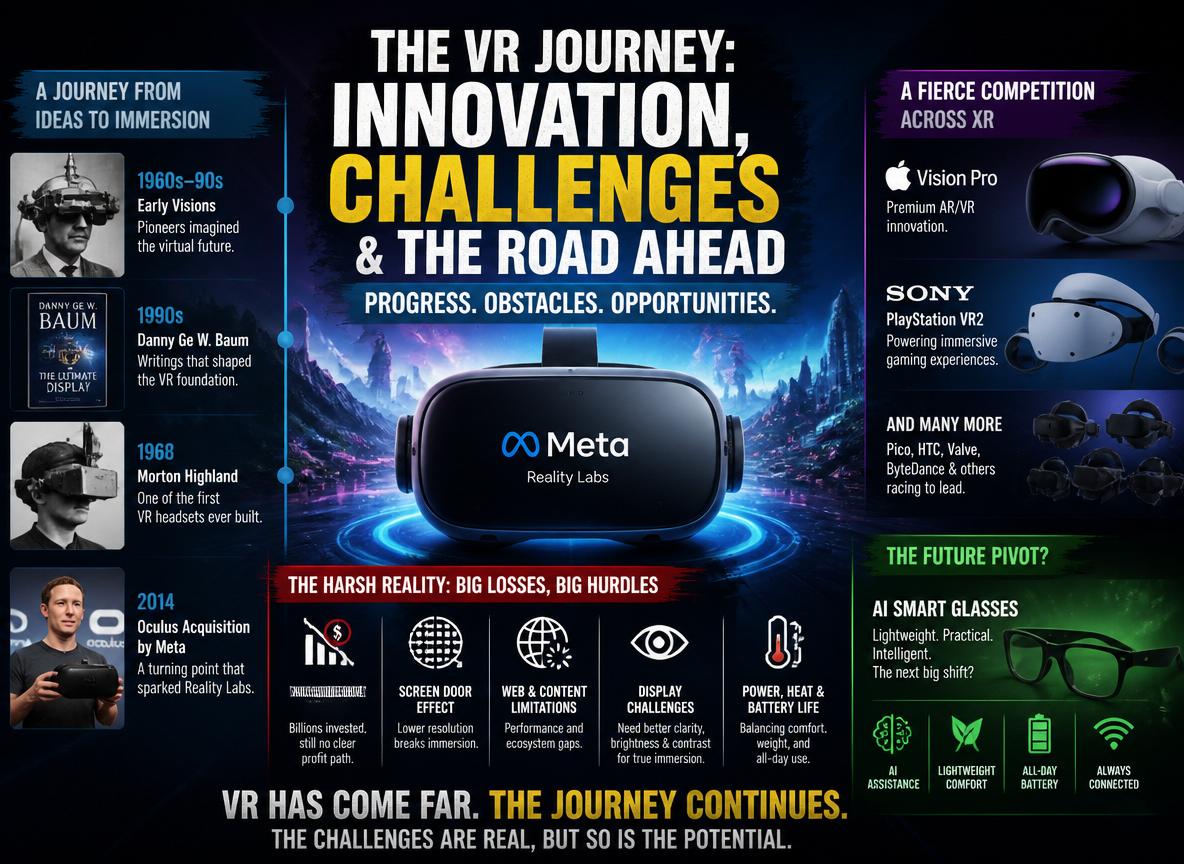
What does it mean for a company to spend heavily on an emerging computing platform? Meta’s Reality Labs segment reported an operating loss of $19.193 billion for full-year 2025; that is a segment accounting result, not the net loss of Meta Platforms as a whole. Meta acquired Oculus in 2014 and continues to invest in virtual reality, augmented reality, and related devices.
VR, as the name suggests, is Virtual Reality.
Historical context
In 1935, more than 90 years ago, Stanley G. Weinbaum’s story Pygmalion’s Spectacles imagined an immersive experience through glasses; that literary vision preceded the hardware.
In the 1960s, Morton Heilig’s Telesphere Mask was an early head-mounted stereoscopic display concept. Its historical significance does not make it mechanically equivalent to a modern tracked headset.
In his 1965 paper The Ultimate Display, computer graphics pioneer Ivan Sutherland described an ambitious vision for interactive computer displays. A later tracked head-mounted display was presented in 1968; the 1965 paper is historical context, not evidence for the later device’s mechanical design.
Jaron Lanier and VPL Research helped popularize the term “virtual reality” and develop early commercial systems and data gloves. Claims about a single inventor or first company are more contested than this simplified history can establish.
Over several decades, VR has experienced cycles of enthusiasm and retrenchment. Meta and Apple have invested in different visions of spatial computing, but whether headsets become a mass-market computing platform remains an open question.
Now that the story is finished, let’s look at today in 2026. What does the development of the VR industry look like? Let’s simply dissect this industry.
Industry chain
INDUSTRY MAP
The VR / XR value chain
Explore the components, headsets and applications behind immersive computing.
Read the full text outline
- VR / XR
- Upstream · Components
- Compute
- Qualcomm XR platforms
- Apple silicon
- Displays & optics
- Micro-OLED displays
- Pancake optics
- Tracking & power
- Cameras and motion sensors
- Eye / hand tracking
- Batteries
- Compute
- Midstream · Headsets
- Device brands
- Meta Quest
- Apple Vision Pro
- Sony PlayStation VR
- Pico
- HTC
- Manufacturing & supply
- Goertek
- Luxshare Precision
- Device brands
- Downstream · Experiences
- Platforms & stores
- SteamVR
- Meta Quest Store
- App Store
- Consumer uses
- Gaming
- Social experiences
- Video and entertainment
- Enterprise uses
- Simulation and training
- Design and digital twins
- Medical education
- Platforms & stores
- Upstream · Components
DEX editorial map based on the accompanying report. Examples are illustrative, not exhaustive or ranked. Companies can operate across several stages; connections show categories, not verified supplier contracts.
Sources: Report sources and original materials. Reviewed 2026-09-29.
First is the upstream of this industry:
Chips: Qualcomm (XR2 series), Apple (M-series + R-series chips).
Display/Optics: Sony (Micro-OLED), BOE, Sunny Optical (Pancake lenses).
Sensors & Batteries: Suppliers of various sensors tracking eye movements and gestures.
Then let’s look at the midstream of this industry (hardware terminal manufacturing): Who makes the headsets we buy?
Brands: Meta (Quest series, affordable mass adoption route), Apple (flagship Vision Pro, high-end spatial computing route), Sony (PSVR products, focusing on console gaming ecosystem), Pico (under ByteDance), HTC.
Contract manufacturers and component suppliers include Goertek and Luxshare Precision. Their consolidated financial reports disclose company-wide results, but do not by themselves reveal or predict the unit sales of an individual headset brand.
Finally, the downstream of this industry (content and application scenarios): What are its application scenarios?
C-end ecosystem: SteamVR, Meta Quest Store, App Store. Core applications are gaming, social (VRChat), and video/film.
B-end applications: Originally used for Air Force flight training and space navigation, later expanded to other fields, such as medical simulation training, industrial digital twins, automobile design, etc.
Competition and adoption
XR (Extended Reality) is often used as an umbrella term for VR, AR and MR. Categories overlap; market-share claims require carefully defined devices and time periods.
Meta sells the Quest series and Apple sells Vision Pro, but a 2026 worldwide market-share comparison requires a specified device category, period, geography and shipment source. Meta’s segment reports include multiple products and do not split headset and smart-glasses sales sufficiently to establish the relative revenue of those categories here.
Apple positions Vision Pro as a premium spatial-computing device. Its market share and competitive effects should not be inferred from a list price alone.
New platforms and lighter glasses may compete for attention, but future product adoption cannot be inferred from announcements alone.
Comfort, fashion, battery life, and the application ecosystem may affect adoption. An earlier attributed quotation about these factors has been removed because its original publication could not be verified.
Technical and commercial constraints
In the current industry context, the VR/XR industry is plagued by four major challenges:
First, image clarity and display cost. Visible pixel structure depends on more than a single screen-PPI threshold, and Micro-OLED is one of several display approaches. High-resolution optics and displays can add cost, but without a bill of materials it is not possible to attribute a specific portion of a headset’s price to one supplier.
Second, vergence-accommodation conflict (VAC). In natural viewing, the eyes converge on an object and focus at its distance; a conventional stereoscopic headset can present a different simulated depth while the display’s optical focal plane remains fixed.
This mismatch can contribute to visual discomfort, although motion, latency, individual sensitivity and other factors also matter. There is no universal severe-nausea rate for all users after a fixed wearing time; device and study conditions matter.
Third, the current standalone VR headset is a heavily integrated electronic product. Chips, cooling fans, complex Pancake lens sets, and even batteries are all stacked around the user’s eye sockets.
Weight distribution, thermal design and fit can limit comfortable use. Rendering, heat, battery capacity and form factor require tradeoffs, but wear time and battery life vary by headset and workload. There is no single physical “impossible trinity” or universal one-hour comfort limit.
Fourth, upstream supply chain and scarce materials.
Supply chains for chips, displays and optics can be exposed to bottlenecks, but the supplied company reports do not establish a direct causal chain from particular minerals to XR display costs. Meta’s $19.193 billion 2025 Reality Labs operating loss is verified in its results; it alone cannot prove why individual suppliers or competitors changed product plans in 2026.
Where the VR/XR industry will ultimately go is a question that only time can answer.
That’s the simplified map for this video. It is a starting point for checking historical sources, company filings and device-specific data—not a forecast of a winner. I’m Dex, see you next time.
Source notes and primary materials
- Meta: fourth-quarter and full-year 2025 results — source for Reality Labs’ 2025 segment operating loss, not a headset unit count or company-wide net loss.
- Ivan Sutherland, The Ultimate Display (1965) — the supplied historical paper about an interactive display vision; not a 2026 product or market forecast.
- Goertek investor relations: 2024 annual report — company-wide filing supplied for manufacturing context; no brand-specific headset shipment claim is inferred.
- Luxshare Precision investor relations: 2025 annual report and Q1 2026 report — company-wide financial filings supplied for manufacturing context; neither independently measures the entire VR market.
The supplied China Mobile Research Institute VR/AR Product Development Status and Trend report dates from November 2022. An original publisher-hosted URL was not verified, so it is recorded here bibliographically rather than linked to an unlicensed copy or used to justify a 2026 market-share claim. The Goertek and Luxshare reports likewise cannot substitute for a defined current shipment survey.
Supplied original documents
The following documents can be opened from their publishers. They are not copied to this website while redistribution rights remain unverified:
- Sutherland, The Ultimate Display (1965): University of Utah PDF.
- Goertek, 2024 Annual Report: publisher-hosted PDF.
- Luxshare Precision, 2025 Annual Report (English): PDF on the company’s disclosure platform.
- Luxshare Precision, 2026 Q1 Report (Chinese): PDF on the company’s disclosure platform.
The supplied 2022 China Mobile Research Institute VR/AR report is not offered here as a download because its publisher-hosted original and redistribution terms have not been confirmed.